jackprior.ai · AI-in-CMC Regulatory Map · Job aid
Manage AI risk in five steps
FDA, EMA, ICH, Annex 22, BioPhorum and GAMP each grade AI in their own vocabulary. Underneath, they all ask the same two questions: how much does the AI influence the decision, and what happens if it is wrong. Grey tags say who each item comes from.
The five steps in one table, then the detail each step leans on: the risk grid, the failure modes, the caveats and the sources the image leaves out.
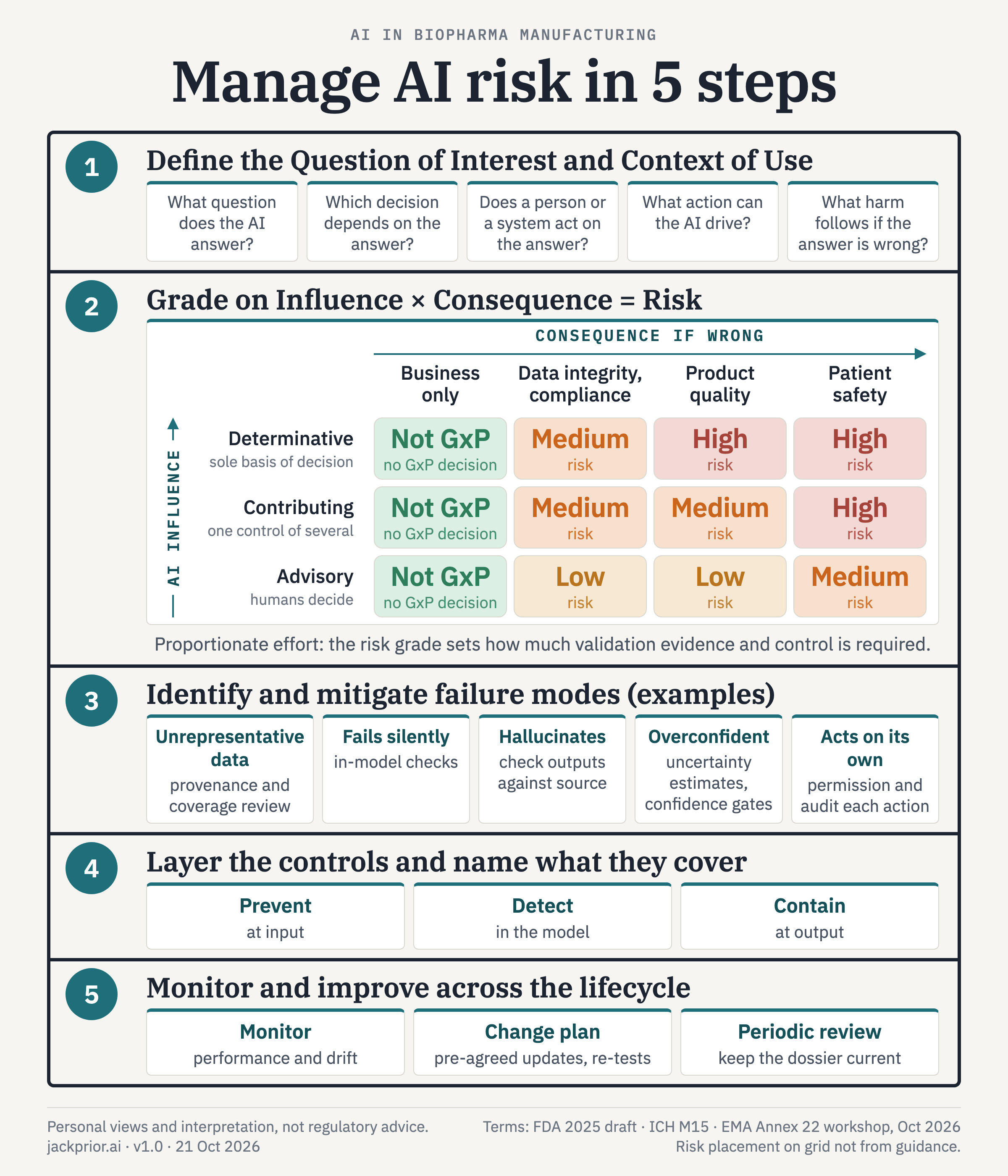
| Step | Why | How |
|---|---|---|
| 1Define the Question of Interest and Context of Use | FDA's credibility framework and ICH M15 both start here: state the question the AI answers, then the context in which the answer is used. Five questions get you there. ASME V&V 40 → FDA 2025 steps 1–2 · ICH M15 · EMA+FDA principle 4 |
|
| 2Grade on Influence × Consequence = Risk | FDA 2025 and ICH M15 call the product "model risk" and grade it low, medium or high, following ASME V&V 40. BioPhorum calls it composite risk. The risk grade sets how much validation evidence, control and oversight is required, and no more. ICH Q9(R1) formality · EMA+FDA principle 2 · FDA 2025 steps 4–7 · ICH M15 · Annex 22 |
|
| 3Identify and mitigate failure modes | The grade says how much evidence is needed. The failure modes say what kind. Same grade, different mitigation, depending on how the AI is built and behaves. These five are on the image; the full list below adds the ones regulators also name. |
|
| 4Layer the controls and name what they cover | Place every mitigation at one or more layers, so no single control is load-bearing, and name the failure mode each one covers. Unanticipated failures are not covered. EMA Annex 22 workshop report, Oct 2026 ("Swiss cheese"; likely to enter the annex as "control mechanisms") |
|
| 5Monitor and improve across the lifecycle | Validation is a lifecycle, not an event. Every 2026 document says so. Improvement is welcome but controlled: a model does not update itself in GMP; every change goes through the change plan and is re-tested. EMA+FDA principle 9 · Annex 22 §10 · FDA SaMD action plan 2021 · GMLP 10 · EMA workshop topic 4 · ICH Q10 continual improvement |
|
2The risk grid
| Consequence if wrong → | ||||
|---|---|---|---|---|
| AI influence ↑ | Business only | Data integrity, compliance | Product quality | Patient safety |
| Determinativesole basis of decision | Not GxPno GxP decision | Mediumrisk | Highrisk | Highrisk |
| Contributingone control of several | Not GxPno GxP decision | Mediumrisk | Mediumrisk | Highrisk |
| Advisoryhumans decide | Not GxPno GxP decision | Lowrisk | Lowrisk | Mediumrisk |
| Risk grade | Example | Equivalents |
|---|---|---|
| Not GxP | Cell-line ranking in development | PtC low · FDA n/a unless it enters a submission · Annex 22 out of scope |
| Low | SOP drafting, QA-approved | PtC low · FDA/M15 low · Annex 22 non-critical |
| Medium | Anomaly alerts acted on by operators | PtC medium · FDA/M15 medium · Annex 22 critical |
| High | Chemometric release assay, autonomous feed control | PtC high · FDA/M15 high · Annex 22 critical |
3Failure modes, the full list
| Failure mode | Mitigation | Source |
|---|---|---|
| Unrepresentative data | Provenance and coverage review before use | FDA 2025 step 4 · EMA+FDA principle 6 · GMLP 2–3 · Annex 22 §4 |
| Fails silently | In-model checks, out-of-distribution detection | ICH Q9(R1) detectability · EMA workshop |
| Hallucinates | Bind outputs to source and verify against it | EMA workshop (RAG with source binding) · NIST AI 600-1 · GAMP AI Guide |
| Overconfident when wrong | Uncertainty estimates, confidence gates | FDA 2025 · ICH M15 · EMA workshop (uncertainty quantification, conformal prediction) |
| Acts on its own | Permission and audit every action; human gate on consequential ones | EMA workshop agentic use case · BioPhorum ("AI must not execute e-signatures") |
| Cannot explain its answer | Explainability sized to the decision; reviewer able to challenge | EMA RP · EMA workshop topic 3 |
| Same input, different answer | Fix settings, or characterise the spread | Annex 22 draft probabilistic gate · EMA workshop |
| Supplier owns the model | Contract for evidence, metrics and change notice | Annex 11 · EMA workshop topic 6 |
| Humans stop checking it | Periodic challenge; reviewer must understand the model | EMA workshop topic 3 · BioPhorum (HITL as risk source) |
Also check
- Regulatory impact: does the output become submission evidence? Business-only output that enters a filing is not "Not GxP" in EMA's scheme. EMA RP, second axis
- EU AI Act tier: high-risk only if a device safety component Reg. 2024/1689 Art. 6
- GAMP category: the computerised-system lens ISPE GAMP 5 · GAMP AI Guide
Caveats
Annex 22 is still a draft. The July 2025 text says dynamic models and LLMs should not be used in critical GMP applications. The October 2026 workshop report records the drafting group discussing a broader scope under a documented control strategy, but no revised text has been published. An EU inspector can still apply the draft.
A human in the loop lowers influence but does not fix a bad model. The workshop report says HITL is one control among several and cannot compensate for inadequate validation; BioPhorum treats it as a risk source as well as a control.
Impact ≠ impact. ICH PtC "high-impact model" and ICH M15 "model impact" are different things. M15's equivalent is model risk.
Influence ≠ influence. BioPhorum's model influence means maturity (autonomy × adaptiveness), not weight of evidence. Re-derive it before using it in an FDA credibility plan.
Five steps compress FDA's seven. Steps 1 and 2 here are FDA's steps 1 to 3; FDA's steps 4 to 7 (plan, execute, document, assess adequacy) sit behind "validation evidence required". Steps 3 to 5 come from EMA and Annex 22, not FDA.
Sources
- FDA 2025
- FDA draft guidance, Considerations for the Use of AI to Support Regulatory Decision-Making for Drug and Biological Products, Jan 2025 (7-step credibility framework)
- ASME V&V 40
- ASME V&V 40-2018, credibility of computational models; origin of FDA's model-risk logic
- ICH M15
- ICH M15 General Principles for Model-Informed Drug Development, adopted Jan 2026
- ICH PtC
- ICH Q8/Q9/Q10 Points to Consider, 2011, model section
- ICH Q9(R1)
- ICH Q9(R1) Quality Risk Management, 2023
- EMA RP
- EMA Reflection Paper on the Use of AI in the Medicinal Product Lifecycle, final Sept 2024
- EMA+FDA
- EMA and FDA, Guiding Principles of Good AI Practice in Drug Development, Jan 2026 (ten principles)
- Annex 22
- EU GMP Annex 22 Artificial Intelligence, draft for consultation Jul 2025
- EMA workshop
- EMA report, Multistakeholder workshop on expert contributions to AI guidance development (Annex 22), Oct 2026
- BioPhorum
- BioPhorum AI risk guidance for the pharmaceutical industry, Jun 2026
- GAMP
- ISPE GAMP 5 (2nd ed., 2022) and GAMP Guide: Artificial Intelligence, Jul 2025
- GMLP
- FDA, Health Canada, MHRA Good Machine Learning Practice guiding principles, 2021
- NIST AI 600-1
- NIST Generative AI Profile, Jul 2024
- AI Act
- Regulation (EU) 2024/1689
- PMF REF
- Pharma Manufacturing Forum industry proposal (unpublished, 2026): Risk Evaluation Framework